
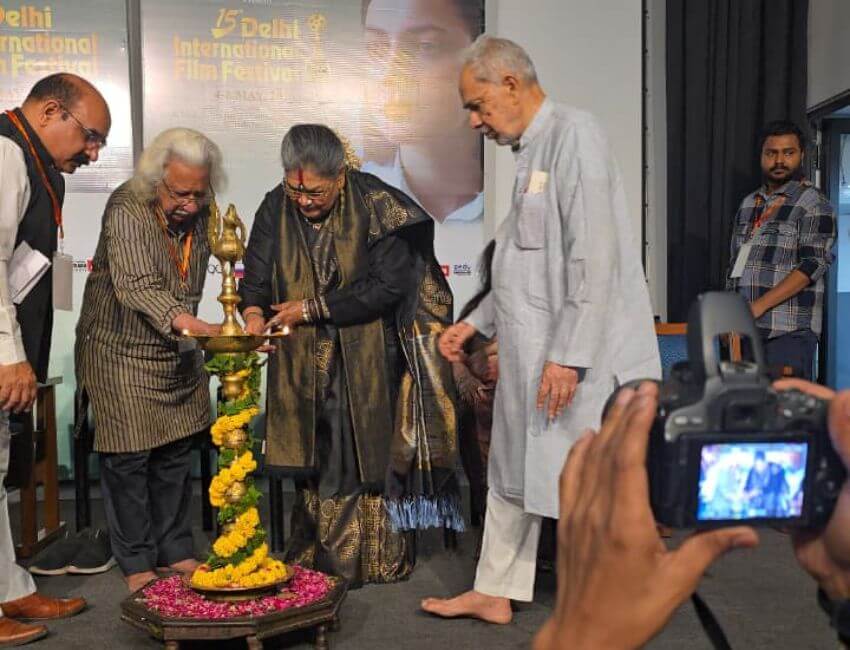
The 15th Delhi International Film Festival (DIFF) 2026—organised jointly by the Indira Gandhi National Centre for the Arts (IGNCA), under the Ministry of Culture, and ‘The Social Circle’—has finally commenced. This prestigious international film festival, hosted in the national capital, Delhi, is being celebrated with great grandeur from May 4 to May 8, 2026, at the Indira Gandhi National Centre for the Arts, Janpath, Delhi. Known globally by its acronym ‘DIFF,’ the Delhi International Film Festival has emerged this year in an even more expansive and global avatar; the event features the screening of 178 films from over 51 countries, while an exhibition of more than 100 artworks serves as a major attraction for the audience. On the occasion of the inauguration, special honors were also conferred upon O.P. Mishra, Anurag Punetha (Media Head at IGNCA), and Chairman Ram Bahadur Rai.
The festival was formally inaugurated by the renowned Malayalam filmmaker and Dadasaheb Phalke Award laureate, Adoor Gopalakrishnan. To mark this occasion, and in honour of the celebrated Moroccan filmmaker Mohamed Ahed Bensouda, his acclaimed film The Divorced of Casablanca is being screened. The renowned Bangladeshi vocalist Runa Laila was honored with the ‘Minar-e-Delhi’ Award, while veteran Indian singer Usha Uthup was presented with the Lifetime Achievement Award. The return of veteran actress Sharmila Tagore to Bengali cinema is being specially highlighted through the screening of her film, Puratan: The Ancient. Starring and produced by Rituparna Sengupta, this film is garnering acclaim across the globe.
This international platform will also witness an impressive presence of prominent figures from Indian cinema, including Rituparna Sengupta, Shweta Menon, and Meghna Malik.
Globally renowned Russian film agency Roskino and Mozambique’s National Film Institute have joined the festival as collaborative partners. This film festival features a special showcase of films from Russia and China, while African cinema remains a key area of focus. Spanning five days, this event will not only screen films but also pave new avenues for cultural dialogue and international cooperation through the medium of cinema. Notably, several films featured in the Indian section of this festival have previously won National Awards, while some international entries have even been submitted for the Oscars. Furthermore, the festival has consistently played a pivotal role in fostering cinematic exchange between India and the rest of the world, facilitating the presentation of Indian film programs at festivals across various nations.
Admission to the festival will be entirely free of charge. The films have been curated by renowned film journalist Anurag Punetha, poet and critic Pramod Kaunswal, and a well-known figure from the television industry, Reema Dinesh Kapoor. The jury will be presided over by Raman Chawla.
The festival has generated considerable interest among both the general public and film critics. This is largely because the Delhi International Film Festival (DIFF) is perceived as a platform that consistently upholds its originality, independence, and authentic character—qualities that have enabled it to establish a distinct identity and reputation over the years.
Ramkishore Parcha, Founder and President of the Delhi International Film Festival, states: “We are committed to presenting the various categories we have curated for world cinema this year with the utmost credibility. In doing so, we will not only highlight the global context of these films but also organize discussions with experts regarding the intricate interplay between cinema and society. We intend to delve into the history of cinema and evaluate it through the lens of social reality.” As in previous years, our endeavor is to ensure that this film festival serves as a distinctive mirror—reflecting humanity, its struggles, and its indomitable spirit—for audiences both within the country and across the globe.
Hosted at the Indira Gandhi National Centre for the Arts, this festival will showcase films across various categories, offering audiences and film critics alike the opportunity to explore the diverse dimensions of cinema. The festival features distinct sections such as World Cinema, Indian Cinema, NRI Cinema, Short Films, Documentaries, and a special Retrospective section. The World Cinema segment presents a curated selection of contemporary and classic films from various nations, offering a global perspective on social, political, and humanistic issues. The Indian Cinema segment encompasses both regional and mainstream films, providing a glimpse into fresh narratives and experimental cinematic expressions. The NRI Cinema category serves as a dedicated platform to highlight the creative prowess of filmmakers from the Indian diaspora, where stories exploring themes of identity, culture, and global experiences take centre stage.
Among the films slated for screening at the festival, several special presentations have already become a subject of considerable buzz. The Divorcees of Casablanca—a film by renowned Moroccan filmmaker Mohamed Ahed Bensouda—has garnered particular acclaim for its sensitive portrayal of the complexities of modern relationships. Similarly, several films selected within the Indian segment are being recognized for their highly impactful exploration of contemporary social shifts, family dynamics, and personal struggles. The short film and documentary categories also feature numerous entries with the potential to compete on the international stage, distinguished by their subject matter, presentation, and technical excellence.